
Race Intel / Field note
How to choose a race weekend that feels like yours
Distance, course, crowd, and the small details that make a start line feel right.
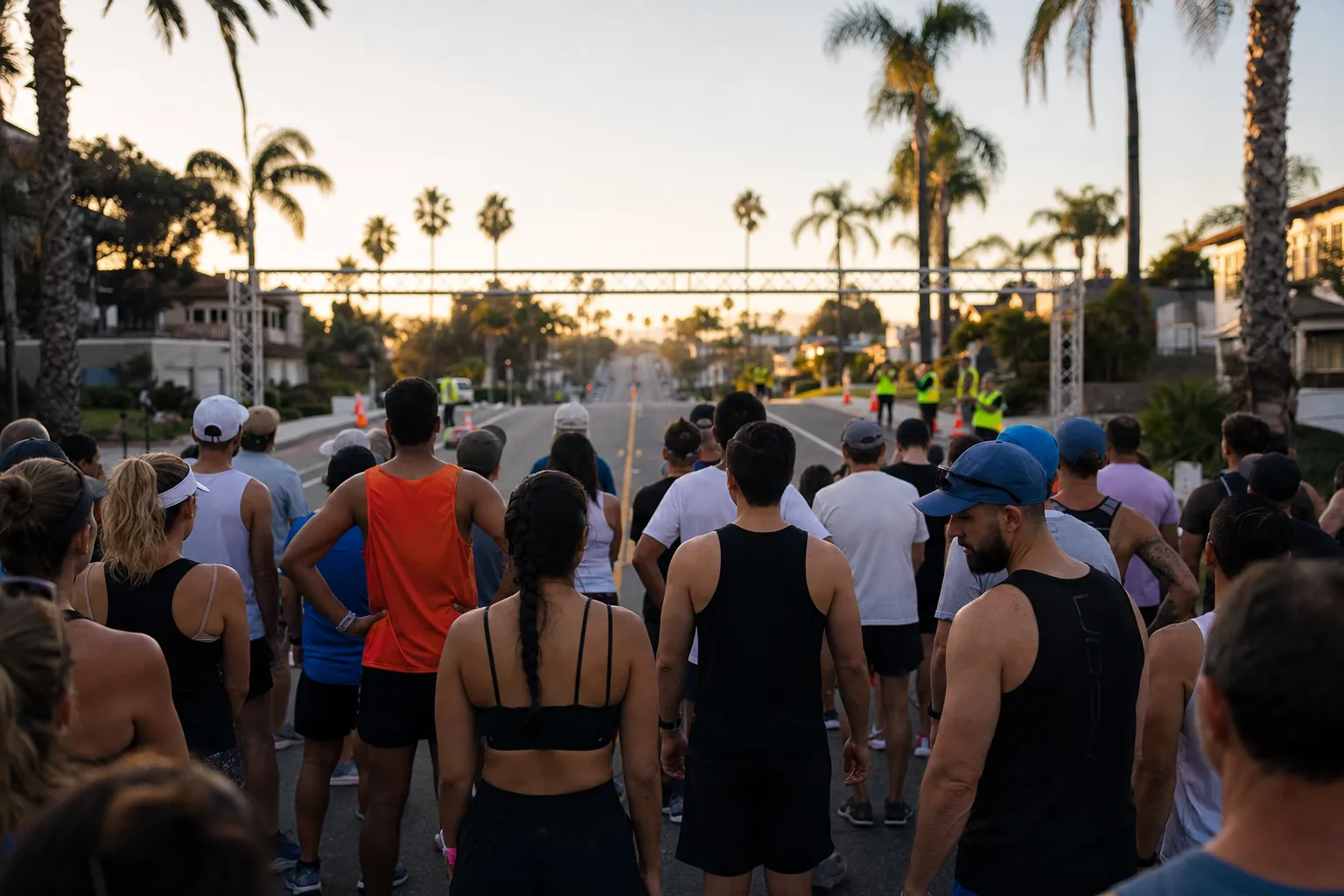
There's a version of race selection that runs entirely on external logic: PRs, course flatness, medal design, what your friends are doing. That logic isn't wrong, but it treats every race like an interchangeable box to check. The races that end up mattering, the ones you talk about years later, usually get picked for reasons that are a little more personal. Here's how to find one of those.
Start with what you actually want out of the day, not the finish line
Before looking at a single race calendar, get honest about what kind of experience you're after. Are you chasing a number? Do you want a destination trip with a run built into it? Are you looking for a low-key morning with your local group, or the roar of 40,000 people crossing a start line together? None of these are better than the others, but a lot of race-weekend disappointment comes from picking a big-city spectacle when what you actually wanted was quiet trail miles, or vice versa. Name the feeling first. The logistics follow from there.
Let the course tell you something about the place
A course is a strange kind of tour, usually the only time you'll ever move through a city or landscape at that pace, on closed roads, with permission to just look around. Choose one that shows you something you'd want to see anyway: a coastline, a historic downtown, a stretch of countryside. Flat and fast is a legitimate priority if you're chasing time, but if this weekend is about the experience, weight the scenery and route personality as heavily as the elevation chart.
Think about the crowd you want to be part of
Race size changes everything about how the day feels. Massive races bring energy, aid stations every mile, and a finish line that feels like a parade. Small races bring quiet, a start line where you can actually hear the gun, and the chance to recognize faces by mile 10. Neither is more real than the other. If you've never run a huge race, try one. The crowd support alone can carry you through rough patches. If you've only ever run huge races, a small local one can feel almost meditative by comparison.
Look past race day to the whole weekend
The race is a few hours; the weekend is the memory. Consider what's around it: is there a shakeout run or a community meetup the day before? A good expo, or just a good cup of coffee near the start? Somewhere to celebrate afterward that isn't a parking garage? Races that build in these small social touchpoints tend to feel warmer and more memorable than ones that are just point A to point B.
Don't ignore the calendar's emotional weight
Some race weekends carry meaning beyond the course itself: an anniversary, a hometown race, one that raises money for something you care about, or one that lines up with a season you'll remember for other reasons. That context can turn an ordinary 10K into something you think about every year. If a date on the calendar already means something to you, that's worth more than a faster course somewhere else.
Give yourself permission to pick the wrong one
The fastest course, the most prestigious field, the one everyone recommends, sometimes none of that matters as much as a small race in a town you love, run with people who make you laugh at mile 20. A race weekend that feels like yours isn't necessarily the most impressive one on paper. It's the one you'd choose again.
What race made your list this year? Share your pick with the community.